




 0
0
 0
0
Your basket is empty...
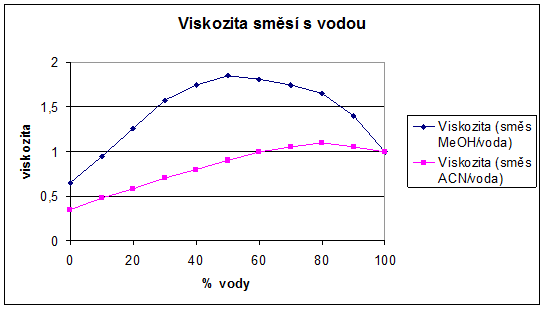
| % of water | Viscosity (MeOH/water) | Viscosity (ACN/water) |
| 0 | 0.65 | 0.35 |
| 10 | 0.95 | 0.50 |
| 20 | 1.20 | 0.55 |
| 30 | 1.60 | 0.70 |
| 40 | 1.75 | 0.80 |
| 50 | 1.90 | 0.90 |
| 60 | 1.80 | 1.00 |
| 70 | 1.75 | 1.05 |
| 80 | 1.65 | 1.10 |
| 90 | 1.40 | 1.05 |
| 100 | 1.00 | 1.00 |
| Particle size (µm) | ID (mm) | Flow (ml/min) | Pressure 150mm* (PSI) | Pressure 250mm* (PSI) |
| 3 | 4.6 | 0.5 – 1.0 | 1000 | 1500 |
| 5 | 3.0 | 0.4 – 0.8 | 750 | 1250 |
| 5 | 4.6 | 1.0 - 2.0 | 700 | 1100 |
| 5 | 10.0 | 5.0 - 10.0 | 750 | 1250 |
| 10 | 4.6 | 2.0 - 5.0 | 400 | 600 |
| 10 | 10.0 | 10.0 - 20.0 | 500 | 800 |
| 10 | 21.2 | 20.0 - 40.0 | 300 | 500 |
* When the flow rate is at the lower limits of the recommended flow rates
| id | Flow | Color | FROM |
| 0.13 mm | Up to 2.0 ml/min | Red | 1/16" |
| 0.18 mm | Up to 5.0 ml/min | Yellow | 1/16" |
| 0.25 mm | Up to 20 ml/min | Blue | 1/16" |
| 0.50 mm | Up to 50 ml/min | orange | 1/16" |
| 0.75 mm | Up to 100 ml/min | Green | 1/16" |
| 1.0 mm | Up to 200 ml/min | Grey | 1/16" |
| 1.59 mm | Up to 500 ml/min | 1/8"". | |
| 2.40 mm | Up to 1000 ml/min | 1/8"". |
Inches to mm - inch x 25.4 = mm
Feet per meter - feet x 0.3048 = meter
Column pressure at a flow rate of 1 ml/min
P = 2.1 xdx 10.13 xh / h 2 x vp 2
P – pressure (MPa)
L – column length in mm
h - dynamic viscosity (for water = 1)
d – internal diameter of the column in mm
vp – particle size in µm
The pressure on the 4.6 x 250 mm, 5 um column will be approx. 100 bar at a flow rate of 1.0 ml/min
| ID (mm) | Injection value (µl) | Column Capacity (mg) | Flow rate (ml/min) |
| 4,6 | 5 - 100 | 1 | 0,5 – 2,0 |
| 10 | 100 - 1000 | 5 | 4,0 – 15,0 |
| 21,2 | 1000 - 5000 | 20 | 10 – 50 |
| 30 | 2000 – 10 000 | 40 | 40 – 100 |
| 50 | 5000 – 20 000 | 120 | 100 – 300 |
| 100 | 10 000 – 50 000 | 500 | 400 - 1000 |
pKa of acidic buffers at HPLC for mobile phase preparation
| Acidic buffer | Temperature (°C) | pK1 | pK2 | pK3 | |
| ACES 2-[(2-amino-2-oxoethyl)amino]ethan sulfonic acid | 20 | 6.9 | - | - | |
| Acetic acid | 25 | 4.8 | - | - | |
| Boric acid | 20 | 9.1 | 12.7 | 13.8 | |
| CAPS 3-(cyklohexylamino)ethan sulfonic acid | 20 | 10.4 | - | - | |
| Citric acid | 25 | 3.1 | 4.8 | 6.4 | |
| Formic acid | 20 | 3.8 | - | - | |
| Glycine | 25 | 2.3 | 9.6 | - | |
| Glycylglycine | 20 | 8.4 | - | - | |
| HEPES N-2-hydroxyethylpiperazine-N'-2-ethan sulfonic acid | 20 | 7.6 | - | - | |
| Imidazole | 20 | 7.0 | - | - | |
| MES 2-(N-morfolino)ethan sulfonic acid | 20 | 6.2 | - | - | |
| MOPS 3-(N-morfolino)propan sulfonic acid | 20 | 7.2 | - | - | |
| Oxalic acid | 25 | 1.3 | 4.3 | - | |
| Phosphoric acid | 25 | 2.1 | 7.2 | 12.7 | |
| TES 2-[tris(hydroxymethyl)methyl]aminoethane sulfonic acid | 20 | 7.5 | - | - | |
| Trifluoroacetic Acid | 25 | 0.3 | - | - | |
| Tricine N-[tris(hydroxymethyl)methyl]glycine | 20 | 8.2 | - | - | |
| TRIS Tris(hydroxylmethyl) aminomethane | 20 | 8.3 | - | - | |
| pKb of Bases at HPLC for mobile phase preparation | |||||
| Bases | Temperature (°C) | pK1 | pK2 | pK3 | |
| Ammonia | 25 | 9.3 | - | - | |
| Diethylamine | 20 | 11.1 | - | - | |
| Dimethylamine | 25 | 10.7 | - | - | |
| Ethylamine | 20 | 10.8 | - | - | |
| Ethylendiamine | 20 | 10.1 | 7.0 | - | |
| Methylamine | 25 | 10.7 | - | - | |
| Morfoline | 25 | 8.3 | - | - | |
| Triethylamine (TEA) | 18 | 11.0 | - | - | |
| Trimethylamine | 25 | 9.8 | - | - | |
Note: The pH range for which the given buffer is suitable is in the range of pK ± 1. The UV Cutoff of the used buffer must also be taken into consideration (table 2).
 Scale down (Method transfer from conventional HPLC to UHPLC)
Sample throughput (How do small particles increase the sample throughput?)
Scale-down procedure from conventional HPLC to UHPLC requires optimizing columns selectivity and efficiency. As soon as we have finished this method development, we can perform a scale-down procedure. A few simple calculations can be used to determine equivalent run conditions. This article descibes them sequentially.
 Adjusting Column Size
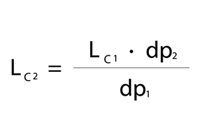
The first calculation determines the appropriate column length. Keeping the same column length while decreasing the particle size will increase the number of theoretical plates in that given column length. Therefore, column length can be shortened without losing resolution. By using Equation 1 and when adjusting the column length properly, we can maintain the same separation.
Once we have determined the proper column length, we can determine the appropriate injection volume. Decreasing the column internal diameter and length, decreases the overall column volume and sample capacity. Therefore, we must alter the injection volume as described in Equation 2. Please note that since overall column volume has decreased, it is important to match the sample solvent to the starting mobile phase composition. Mismatched sample solvents can cause irreproducible retention times, efficiencies, and even changes in selectivity.
 Adjusting Flow Rate
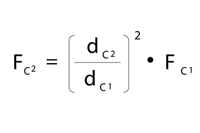
Flow rate must be adjusted to maintain comparable linear velocity through a column with smaller internal diameter. Linear velocity is defined as the distance mobile phase travels over time, whereas flow rate is the volume of mobile phase that travels over time. To maintain the same linear velocity, which is important to maintain efficiencies, flow rates must be decreased as column internal diameter decreases. Also, since smaller particle sizes give rise to higher optimal linear velocities, isocratic flow rates should be calculated with particle size taken into account. Equation 3 can be used to simply and quickly estimate the adjusted flow rate needed for equivalent chromatography. It is also important to note that <2µm particle sizes are less affected by higher flow rates, and therefore faster flow rates can be used in isocratic systems without detrimental effects on peak efficiency.
Lastly, after we have determined the proper column length, injection volume, and flow rate, we can find the equivalent time needed for gradient or step elutions. As an analytical method is scaled down, the time program needs to also be scaled down to keep the phase interactions the same. Time can be adjusted using Equation 4.
Article referene: Rick Lake, Restek Coroporation
| % of water | Viscosity (MeOH/water) | Viscosity (AcCN/water) |
|---|---|---|
| 0 | 0.65 | 0.35 |
| 10 | 0.95 | 0.50 |
| 20 | 1.20 | 0.55 |
| 30 | 1.60 | 0.70 |
| 40 | 1.75 | 0.80 |
| 50 | 1.90 | 0.90 |
| 60 | 1.80 | 1.00 |
| 70 | 1.75 | 1.05 |
| 80 | 1.65 | 1.10 |
| 90 | 1.40 | 1.05 |
| 100 | 1.00 | 1.00 |
Capillary selection for various flowrates
Column selection in dependance on injection volume and its capacity
Mobile phase aditivum UV cutoff
pKa of acidic buffers at HPLC for mobile phase preparation
pKb of Bases at HPLC for mobile phase preparation
Pressure conversion
Pressure estimation in dependance on particle size, diameter, and column length
Solvent characteristics
| Parameter | Characteristics |
|---|---|
| Sorbent strength/type | medium/strong carbon black |
| Specific surface area | approx. 240 m2/g |
| Approx. analyte volatility range | n-C3/4 to n-C6/7 (BP 50 to 150°C) |
| Example analytes | light hydrocarbons, 1,3-butadiene, benzene (for 2-week exposure) |
| Sorbent maximum temperature | > 400°C |
| Recommended conditioning temperature | 350 to 400°C |
| Recommended desorption temperature | 350 to 400°C ((but below conditioning temperature where possible) |